
'Songs for Europe' CD
Philip Jeck & Janek Schaefer.
Asphodel [USA] # ASP2026 Buy your copy here! .
Released September 21st 2004 in heavy weight 6 page digipack.
We are touring this project. If you would like to discuss booking a concert then please email Janek for a chit chat.
Asphodel
A> 763 Brannan Street — San Francisco (CA) 94103 — USA
P> +1/415 863-3068 F> +1/415 863-4973 E> info@asphodel.com W> http://www.asphodel.com/
Philip Jeck & Janek Schaefer
‘Songs for Europe’ CD Asphodel 2026
Running time: 52:33
Track listing:
1. Taxim...................>.play short Real Audio low resolution extract
2. Istanbul Drift
3. Aegean Tea
4. Song for Europe ..>.play short Real Audio low resolution extract
5. Acropolis Now
6. Kerameikos..........>.play short Real Audio low resolution extract
7. Lullaby Duel.........>.play short Real Audio low resolution extract
'Songs for Europe' is the highly anticipated recording by two of the most respected names in experimental music. Philip Jeck and Janek Schaefer are best known for their work using vinyl and record players in creative ways through performance and installation. On their debut album together they have produced music that bursts with energetic character, fleeting melodies and skittering rhythms that all translate an evocative sense of place.
In 1978 Philip first met 8 year old Janek performing a dance duo with his mum at the X6 warehouse on the banks of the river Thames. They next met 18 years later at the Royal College of Art where Janek was studying architecture and Philip was performing an afternoon concert while showing a video of his seminal installation ‘Vinyl Requiem’. This meeting directly inspired Janek to make his first multi-arm record player and to begin working with sound from vinyl. Finally, 8 years later in 2004, following many on stage collaborations, they spent two weeks on location in Istanbul and Athens producing ‘Songs for Europe’.
As an architect turned sound artist, Janek has always been interested in creating music that is site specific, music created from the context where it’s made. For this project, the basis for their collaboration became Cultural context. By using locally bought LP’s and 45’s of Turkish and Greek music, the records became the primary source material for their improvisation sessions. In Istanbul they worked on the top floor of an office block overlooking a city ravaged by a two day power cut snow storm. They collected vinyl from candle lit shops, and scanned the radio dial searching for stray waves. In pre Olympic Athens they were invited to stay and work in a decaying 30’s building at the foot of the Acropolis, accompanied by a pile of vinyl at the bottom of the sweeping stairs. The final tracks were basically edited ‘on screen’ in Athens without any further manipulation.
Artwork designed by Janek and Philip using photographs taken on location, where they first discovered that they're both half Polish. The album subtitle...'Piosenki dla Europy' is a dedication to their parents shared history.
We hope 'Songs for Europe' communicates the great pleasure we shared in producing it together’. [Janek & Philip]
>
Philip and Janek working between powercuts in Istanbul, January 2004 [Session 1]
300dpi full size photo for press - just drag and drop onto desktop to use it [let me know if you do, thanks] 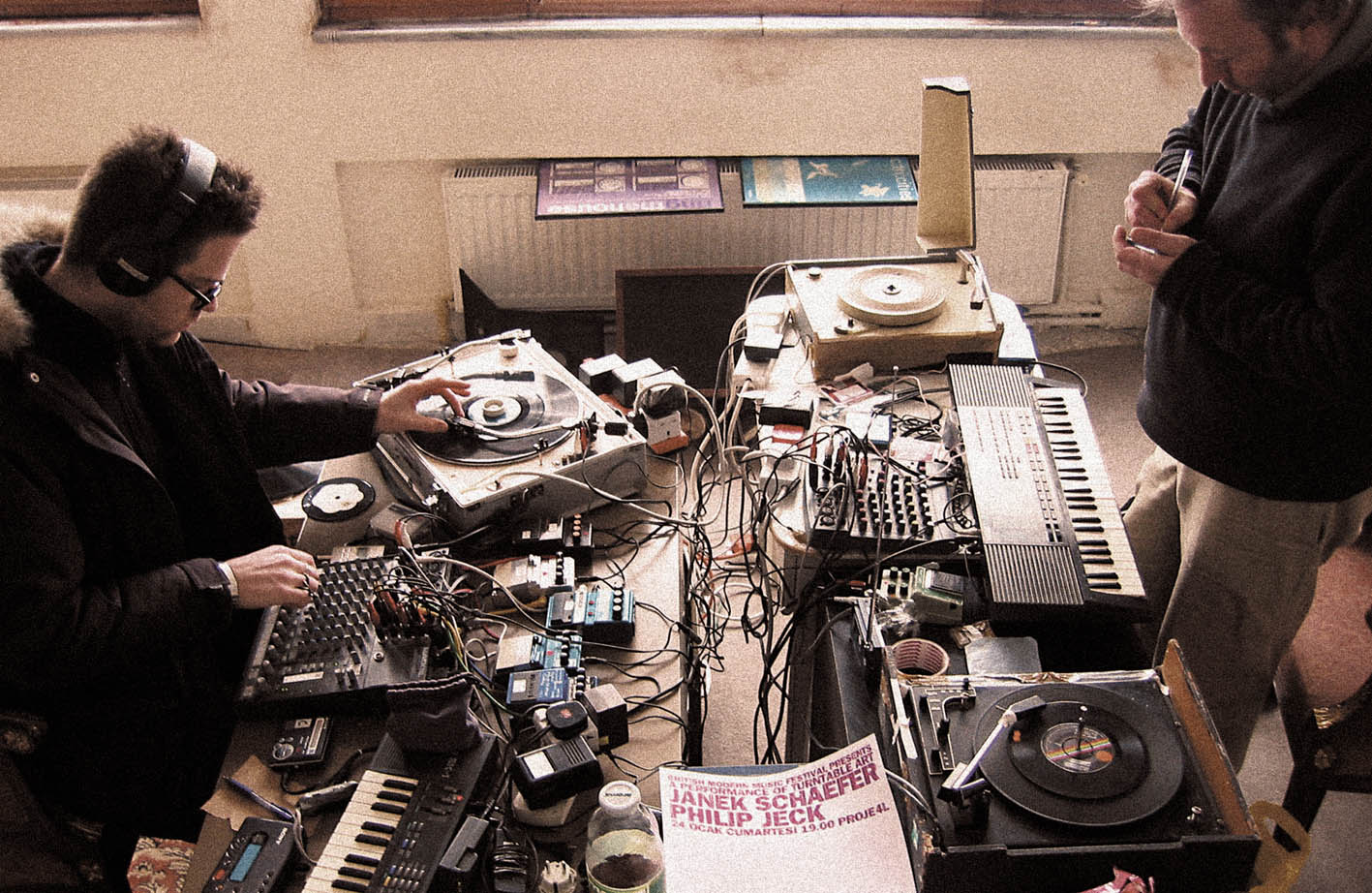
Aquarius Records [USA]
>
We just can't get enough of this stuff. The music of dreams. The music of darkness and light. The music of life, slowed down and observed from within.
A new Philip Jeck record! What could be better. Well, how about adding fellow turntable experimentalist Janek Schaeffer to the mix? Then how about taking the two of them, equipped with all manner of antique record players, setting them up in an abandoned thirties office building at the foot of the Acropolis, and having them gather source material only from used record shops, a motley collection of second hand Greek and Turkish lps and 45's. Sounds like heaven. And it is. Schaeffer often seems focused on rhythm and source material, while Jeck's aim is more emotion and ambience, thus the two work perfectly together. Slowly shifting shades of darkness, move sluggishly like sonic ice floes, snippets of mubled vocals struggle against record crackle and skipping loops of distorted orchestration.
The whole record is a series of fuzzed out ambient soundscapes, smeared deftly into indistinct outlines, voices float by like clouds, rhythms emerge from the murk, having fallen together seemingly randomly by the overlap of assembled sonic striations, rumbling crunch, slowed down into a thick sonic mulch, wavering melodies cloaking the horizon in glimmering sonic dew, guitar melodies deconstructed into distant frameworks, surrounding static swirls of sweetness and occasional bursts of violent skree. Horns squeal and are quickly subsumed by thick slowly bubbling pools of strummed mumbly guitars and minor key lullabies. Dreamy and heavenly.
The Wire (Jim Haynes)
>
In both their respective bodies of experimental turntable work, Philip jeck and Janek Schaefer have extracted secret histories from the grooves of well worn vinyl while retaining their own distinct signatures. By emphasising surface noise, dusty ambience and haunted melodies, jeck invokes a transportation of time. Schaefer, on the other hand, with his background in architecture, located sound within specific spaces. Songs for Europe tactfully combines the two artists' preffered methodologies into a seamless cohesive body of work.
The All Music Guide (Francois Couture)
>
Philip Jeck and Janek Schaefer have shared the same stage -- with and without performing together -- numerous times as part of avant-garde music events, namely the Martin Tétreault curated turntablist ensemble that toured England in the early 2000s. 'Songs for Europe' is their first full-length collaboration and certainly deserves more than a footnote in their respective discographies. In fact, this album is one of Jeck’s best efforts since {^Vinyl Coda IV}, as it eschews facile ambient textures in favor of a harsher discourse, and Schaefer’s most “accessible” album in recent times, after a string of very strong yet much more demanding releases (Cold Storage) and (Black Immure), in particular. The main theme, found
in the album title, the artwork, and most of all the sound sources, is Turkey. Jeck and Schafer are spinning and sampling a wide range of Turkish (and possibly Greek) music, from classical to rock, by way of traditional folk. The crackling of old vinyl is omnipresent, especially at the beginning and end of each of the album’s two main sections. The first three tracks
could be seen as making up “side one” of the CD, the highlight being the 10-minute long {&“Aegean Tea.”} Opening on a rough rock recording all but drowned in surface noise, the piece moves to quieter pastures before turning into an orgiastic orchestra of assembled sound sources. The second side, consisting of the next three tracks, is somewhat calmer than the first, but follows the same aesthetics: ambient textures that are actually quite harsh, a strong sense of place that is actually severely displaced, a high level of plundering that is hiding an even higher level of composition (instant or not). After the two “sides” comes the “bonus track,” the four-minute 'Lullaby Duel', a surprisingly quiet and innocent guitar solo (or so it seems), taken from who knows where and extremely disorienting after the thickly ornamented tapestries that came before it. Then again, Jeck and Schaefer are two skilled mystifiers and Songs for Europe captures them at the top of their art.
Pitchfork Media [USA] (Cameron Macdonald)
>
Can a record accurately "describe" a city or emulate its inhabitants' senses of romance, ennui, numb routine, triumph, and occasional need for escape? Avant-turntablists Philip Jeck and Janek Schaefer tackle those challenges on Songs for Europe, painting portraits of Athens and Istanbul by treading deserted streets and trying to reanimate those lanes and avenues with their recordings.
Jeck is a vinyl mortician who mixes discarded records and their decayed sounds as if circulating formaldehyde through their grooves. Schaefer finds peace in discord, employing his custom "triphonic" or three-armed turntable. His musique concrete pieces tend to evoke an ominous sense of mortal doom, yet enrapture in the process. Songs for Europe fuses Jeck and Schaefer's methodologies as the pair chisel haunted soundscapes from Greek and Turkish records purchased in each nation's ancient city. The political baggage could be tremendous: Centuries of Greek-Turkish history are blood-written-- from the Ottoman conquest to the present territorial strife in Cyprus. The thematic dread of Songs could dramatize this conflict, but the music is so typically Jeck and Schaefer that such speculation is moot. While listening to their raw palette, it's instead easier to visualize over 2,000 years of history touchable on every brick of the Acropolis or St. Sophia.
The album's seven tracks are divided between the two cities where they were recorded, yet they all share a similar and rather monotonous mood. Jeck and Schaefer mainly chose to sample and bleed together folk records to sound melancholic-- often tying 20 pounds of rocks to string ballads floating on a river. Their looped samples also mechanize the soulful expressions caught on the records-- like faint memories that must be routinely recalled.
Istanbul is introduced in "Taxim", a funeral march that simmers with a boiler-room drone amongst scattered tinny, insectoid guitar melodies. Contorting the song's impact are abrupt blasts of corroded rock Ôn' roll and random radio dial twirling. The stronger "Istanbul Drift" loops what sounds like construction site hammering while a Muslim prayer chant pollinates the air. Such industrial harmony brilliantly phases through a subwoofer-abusive bass rumble and a flower pedal-picking guitar solo. It's this symbiosis between the machine and the soul that makes Songs for Europe so unforgettable.
The Athens tracks are denser and glummer. "Song for Europe" melts accordion samples into a stream of ether with female dishwasher operas and oceanic drones sailing toward the horizon and falling off the world's edge. "Acropolis Now" (ugh), is another danse macabre-- this time led by prancing reeds and violins, along with a supernatural, stylus-flickered organ loop that pans between the stereo channels.
Making the best use of the seesawing stereo is the closer, "Lullaby Duel"-- the one instance on Songs that Greek-Turkish tension is potentially addressed. The first half of the track is a sore-throated ballad of gentle, harmonic feedback, bass guitar jangles, and sandpapered vinyl noise. A guitar duet then emerges from the mire, with each performer separated by the stereo channel. After they pluck a melody, they jump to the next channel to keep their careful distance. Jeck and Schaefer then let a turntable stylus run off the record and their phono cartridge buzz for over a minute. It's a reminder that recorded music is nothing more than domesticated electricity kept alive by machines.
Naninani [France]
>
Très belle construction concrète lyrique et sensitive, parfois traversée de ritournelles mélodiques fantômatiques et de l'âme des derviches tourneurs...à base de field-recordings, de vynils, de rock...
Exclaim [Canada]
>
The music fom these exotic sources was engaging and occasionally rapturous!
Downtown Music gallery [Canada]
>
Often mesmerizing and occasionally disturbing.
The Guardian [UK]
>
Songs for Europe shows that their sound-sculpting methods - the looping and transformation of recordings through modified turntables - are all about listening. Like Oliveros, they're at their best when they "disappear".
Gonzo Circus [Belgium]
>
Acht jaar waren Philip Jeck en Janek Schaefer toen ze elkaar voor het eerst op een dansfeestje ontmoetten. De vonk sloeg pas achttien jaar later over wanneer Janek Schaefer als student architectuur een namiddagconcert van Philip Jeck bijwoonde. Jeck, toen al een gerespecteerde geluidsontdekker met een fascinatie voor de vele mogelijkheden van vinyl, toonde er zijn videoproject ‘Vinyl Requiem’. De ontmoeting inspireerde Schaefer tot het ontwerpen van één van zijn eerste meerarmige platenspelers, het instrument waarmee hij later enige faam zou verwerven. Nog eens acht jaar later is hun eerste samenwerking, ‘Songs For Europe’, een feit. Jeck en Schaefer namen de plaat op in Istanbul en Athene en lieten zich, eigen aan het werk van Schaefer, inspireren door de omgeving. Vinylsingles en tapes met radiosignalen vormen de basis voor hun hybride, avontuurlijke zwerftocht. Vooral in nummers als ‘Acropolis Now’ en ‘Taxim’ voel je hoe de twee meesters elkaar perfect aanvoelen, elkaar de ruimte geven en de puzzel zacht in elkaar laten passen. Vaak loopt het ritme uit de maat en is het loopje onafgewerkt, maar net die details maken van ‘Songs For Europe’ een uitdagende geluidservaring. ‘Song For Europe’ toont Jeck en Schaefer op het absolute toppunt van het kunnen. Wie hun vroeger werk kent, weet wat dit wil zeggen, ‘Songs For Europe’ is een plaat buiten categorie, straks zweeft ze in een baan rond het heelal. (www.asphodel.com) (pds)
Friend of the Devil [UK]
>
Two masters of field recordings and processing sourced sounds have collaborated on this intriguing celebration of European unity and diversity. Taking inspiration and sounds from Turkey and Greece, the duo have created audio which falls into beautiful slipstreams of textures. But by no means is this a crass assemblage of everything Mediterranean. The intent is to create an exotic atmosphere rather than a documentary. The interweaving of sounds is exhuberent, from pure noise drones picked up from vehicles or machinery to ringing beats almost touching the work of Aube while others are fragments from locally bought vinyl records and radio broadcasts.
Of course, we can ask if there is a political side to this. Turkey is a hugely sensitive country in relation to its borders and Human Rights record so one wonders if that should have been touched upon in one way or another, though for anyone who has visited these countries, the sheer power of their street life and countryside is enough of a distraction for sound artistes to work on.
While each of the seven tracks are structured in a similar manner, the power lies in the detail, so it would be wise to prick up your ears as fleeting impressions add colour with each listen, and become absorbed in this very rewarding project. 8/10 [Satpal Kalsi]
AllAboutJazz.com [Italy]
>
Non c'e' che dire: l'accostamento tra due artisti come Philip Jeck e Janek Schaefer e' - gia' sulla carta - molto stimolante! Due artisti accomunati dall'utilizzo creativo di vinili e giradischi, due artisti che si sono incrociati rapidamente diverse volte nelle loro esistenze a Londra, ma che hanno anche scoperto una comune ascendenza polacca.
Due artisti il cui lavoro sul materiale registrato e' al tempo stesso una rielaborazione creativa e una iterata esasperazione del momento, del frammento [Schaefer e' noto per i propri giradischi modificati, in cui l'utilizzo di piu' braccetti consente una lettura contemporanea di diverse parti del disco], quasi una discesa nel tessuto stesso della musica.
Il progetto che li vede assieme e' alla fine un diario di viaggio, diviso tra Turchia e Grecia, itinerario realmente vissuto nel 2004, durante il quale la suggestione dei luoghi era rinforzata dall'utilizzo di vinili [sia a 33 che a 45 giri] di musica locale, comprati e trovati in loco.
Laddove un lessico postmoderno e piu' leggero avrebbe sintetizzato i contrasti con ipercinetiche virate di gusto, Schaefer e Jeck fanno invece avvolgere i suoni che traggono dai dischi in spire tormentate, in loop scuri, quasi bloccati, contrastati, che sembrano quasi riecheggiare le contraddizioni dolorose di quelle terre piu' che la loro solare superficie.
Le prime tre tracce, composte a Istanbul, portano in se' frammenti polverosi di canti religiosi, di lugubri borborigmi, l'arpeggio malinconico di una chitarra, il tutto con un senso molto intenso della costruzione drammatica, attento a non utilizzare mai il cambio di atmosfera e di materiale come diversivo estetico.
Non c'e' dubbio che questa Turchia, come percepita attraverso una radio fuori sintonia, sia un luogo in cui tante forze, positive e negative, riecheggiano, cosi' come hanno riecheggiato nei secoli. Si percepisce come un senso di disagio nell'immettere nel "meccanismo" della modernita' il materiale popolare, irrigidendolo nelle spire della ripetizione... la metafora puo' sembrare evidente, indipendentemente dalle intenzioni dei due artisti.
Un blocco di altri tre pezzi proviene invece da Atene: gia' con il brano che da' il titolo al disco, "Song for Europe", ci troviamo di fronte a un ribollire di suggestioni, tra fisarmoniche e canti ipnotici, tra un vento che soffia caldo e il suono di cardini lontani che aprono [o chiudono?] porte invisibili, per pervenire a una zona luminosa, distesa.
Molto bella anche "Acropolis Now" [il gioco di parole del titolo e', a seconda dei gusti, spassoso o imbarazzante...], ricchissima di strumenti che si incrociano, cadenzata da un organo severo, da particelle che si scambiano di posto, per pervenire poi all'atmosfera misteriosa di "Kerameikos".
Nel finale, con "Lullaby Duel", le culture, le suggestioni si incontrano/scontrano, dapprima aprendo uno di quegli scorci che brulicano di insetti, di polvere sul vinile, per poi abbandonarsi al suono malinconico della chitarra, quasi isolata, quasi una voce che riannodi le fila del discorso prima che svanisca nel silenzio. Un finale suggestivo per un disco davvero interessante. [Enrico Bettinello]